
The First Question Everyone Gets Wrong
Most people sit down to write their marriage biodata and immediately Google a template. They fill in the blanks, export it as a PDF, and think the job is done.
But here's what that approach misses: a biodata isn't just a form. It's a first impression. It's the document a family reads before deciding whether they even want to have a conversation with yours.
So the real question isn't just "what fields do I fill in?" — it's "what information actually matters, and how do I present it well?"
This guide answers both.
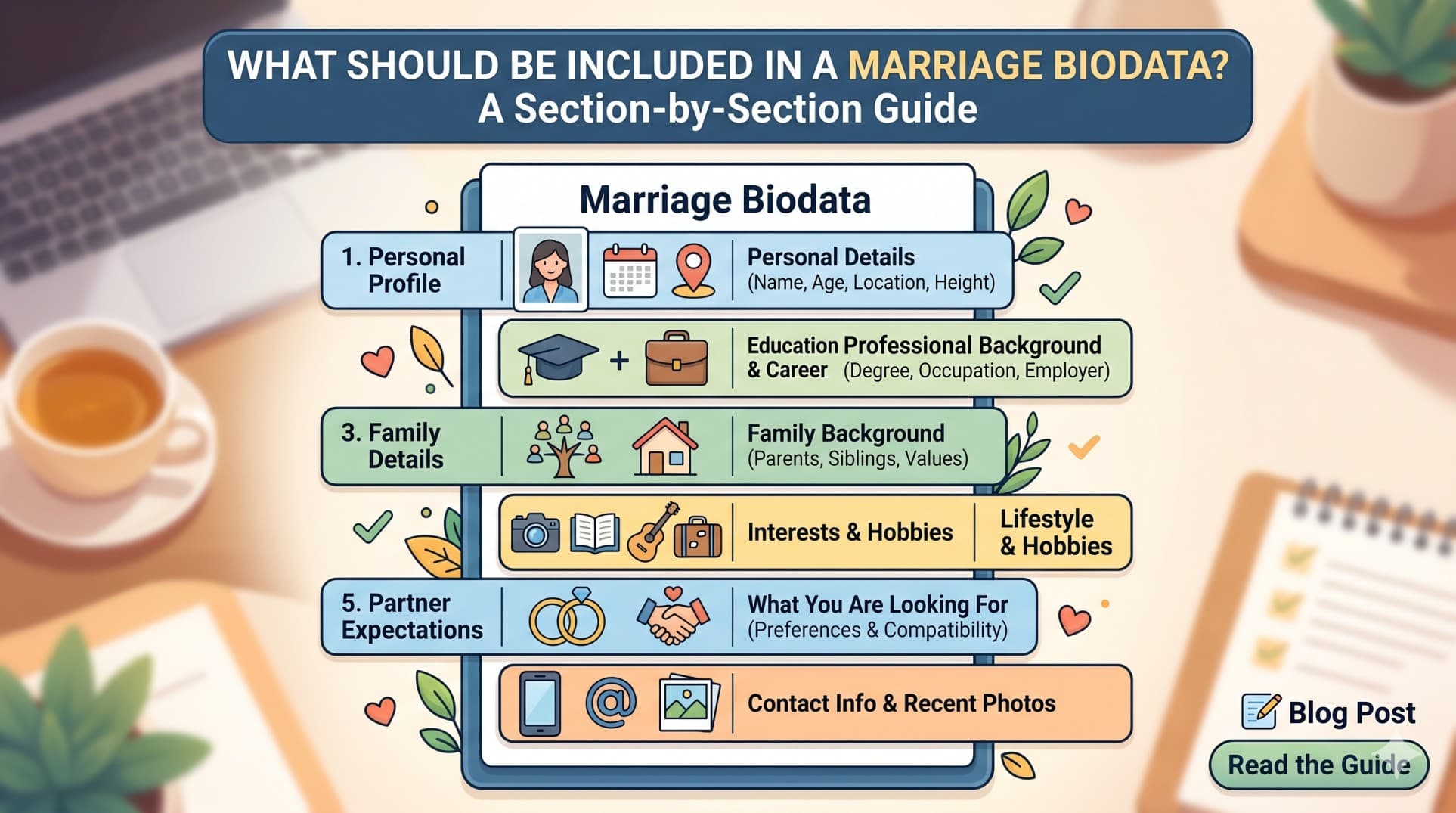
1. Personal Details — Keep It Clean and Accurate
This is the foundation. A well-prepared biodata should be comprehensive yet easy to navigate, starting with personal details: full name, age, gender, and contact details.
Here's what to include:
Full name (as it appears on official documents)
Date of birth and age
Height
Religion and caste (if relevant to your community)
Mother tongue
Current city and state
Complexion (optional, but often expected in traditional formats)
Marital status
Keep this section factual. No adjectives, no self-praise — just clear information. This is not the place to say you're "attractive" or "well-settled." Let the rest of the biodata do that work.
2. Educational Background — Qualifications, Not a Transcript
Mention your highest degree, the college or university, and your field of study. If you have a professional certification that adds context — like a CA, MBA, or UPSC rank — include that too.
You don't need to list every school you attended. Families care about where you ended up, not every step of the journey.
Example: B.E. in Computer Engineering — Pune University (2018) MBA — Symbiosis Institute of Business Management (2020)
One or two lines is plenty.
3. Professional Details — Be Honest About What You Do
Professional information should cover your job role, organisation, and career achievements. A salary range is optional, but many families do expect it — and being transparent here actually builds trust rather than creating awkwardness later.
What to include:
Current job title
Company name or industry (e.g., IT / Banking / Government)
City where you work
Annual income (optional but helpful)
What to skip: your entire work history, your LinkedIn summary, or a paragraph about your career ambitions. This is a biodata, not a cover letter.
4. Family Background — The Section Families Read Most Carefully
For most Indian families, this section carries significant weight. Family background covers parent names and occupations, siblings, and family values
A good format:
Father's name and occupation (or "Retired" if applicable)
Mother's name and occupation / homemaker
Siblings — how many, whether they are married, and a brief note on their profession
Whether the family is nuclear or joint
Native place or hometown (different from current city)
You don't need to write a family essay. Three to five lines is enough. Families want to know who they're connecting with — their background, their standing, their values.
5. About Me — The Section Most People Waste
This is the one section where you actually get to speak in your own voice, and most people fill it with the same five lines everyone else writes:
"I am a simple, family-oriented person who believes in traditional values and is looking for a caring partner."
That tells a family nothing meaningful. Creating a compelling marriage biodata is both an art and a science. While every biodata should reflect your unique personality, there are certain essential elements that can make or break your matrimonial profile.
Write something real. What do you actually do on weekends? What kind of home do you want to build? What matters to you in daily life?
A better example: "I'm a software engineer based in Pune who loves weekend treks and cooking South Indian food at home. I come from a close family where Sunday lunches are non-negotiable. I'm looking for someone I can genuinely talk to — about big things and small ones."
That's three sentences. It's specific. It's human. It's memorable.
6. Hobbies and Interests — Be Real, Not Impressive
List three to five things you actually enjoy. Not what sounds good. Not "reading, travelling, and socialising" just because everyone writes that.
Hobbies and lifestyle — interests, habits, and daily activities — help families understand the person behind the qualifications.
If you play badminton three times a week, write that. If you're learning the sitar, mention it. If you're genuinely obsessed with Formula 1, put it in. These small details spark real conversations and help someone picture a life with you.
7. Religious and Astrological Details — Cultural, Not Compulsory
A South Indian biodata may include astrological details for horoscope matching, while a modern biodata may omit this entirely. It depends entirely on your community and family preference.
If it matters to your family:
Gotra
Nakshatra / Rashi
Manglik status
Time and place of birth (for horoscope matching)
If your community doesn't prioritize these, it's perfectly fine to skip this section altogether.
8. Partner Preferences — A Wish, Not a Contract
This section trips a lot of people up. They either write nothing (which feels vague) or write a long list of requirements (which feels cold).
Partner preferences should cover desired qualities and expectations, with a focus on lifestyle, values, and compatibility.
The right tone is warm and open — not transactional. Write about the kind of relationship you want to build, not the resume you expect to receive.
Avoid: "Looking for a fair, tall, earning 15+ LPA, working in MNC, from same caste."
Better: "Looking for someone who is kind, grounded, and values family. Open to discussing everything else in person."
The first version reads like a job description. The second sounds like a real person.
9. A Clear, Recent Photo
While people should accept all of you, looks do matter in relationships — so add a clear and clean photo to help make a good first impression.
One well-lit, recent photo where you're dressed appropriately and looking natural. No filters, no group shots, no old photos from a cousin's wedding where you've been cropped out.
If you can include two or three photos — a formal one and a casual one — that's even better.
10. Contact Details — Make It Easy to Reach You
Share contact details like a phone number, email address, and preferred social handles. Include your or your parent or guardian's contact information to allow potential matches and their families to connect effortlessly, and ensure all details are accurate and up-to-date.
At minimum, include:
Your mobile number
One parent's number (father's or mother's)
An email address
Double-check these before sending. A wrong digit in a phone number is one of the most avoidable reasons a conversation never starts.
What You Should Leave Out
Knowing what not to include is just as important:
Childhood nicknames or too-personal details that add no relevant information
A full work history going back years
Salary expectations from a partner (comes across as demanding)
Negative statements about past experiences
Excessive spiritual or philosophical descriptions in a personal profile
Keep your biodata to one to two pages for an individual profile. Use bullet points and headings — it should present concise, accurate information that helps families assess compatibility quickly.
The Honest Truth About Biodata
A biodata won't find you a life partner on its own. But a thoughtful one opens the right doors. It tells a family that you're serious, self-aware, and respectful of the process.
The families who are right for you will notice the small, genuine details. The ones who skip past your hobbies to only look at your salary — well, that tells you something too.
Write it honestly. Keep it clean. Update it as you grow.