
Marriage Biodata Format by Profession
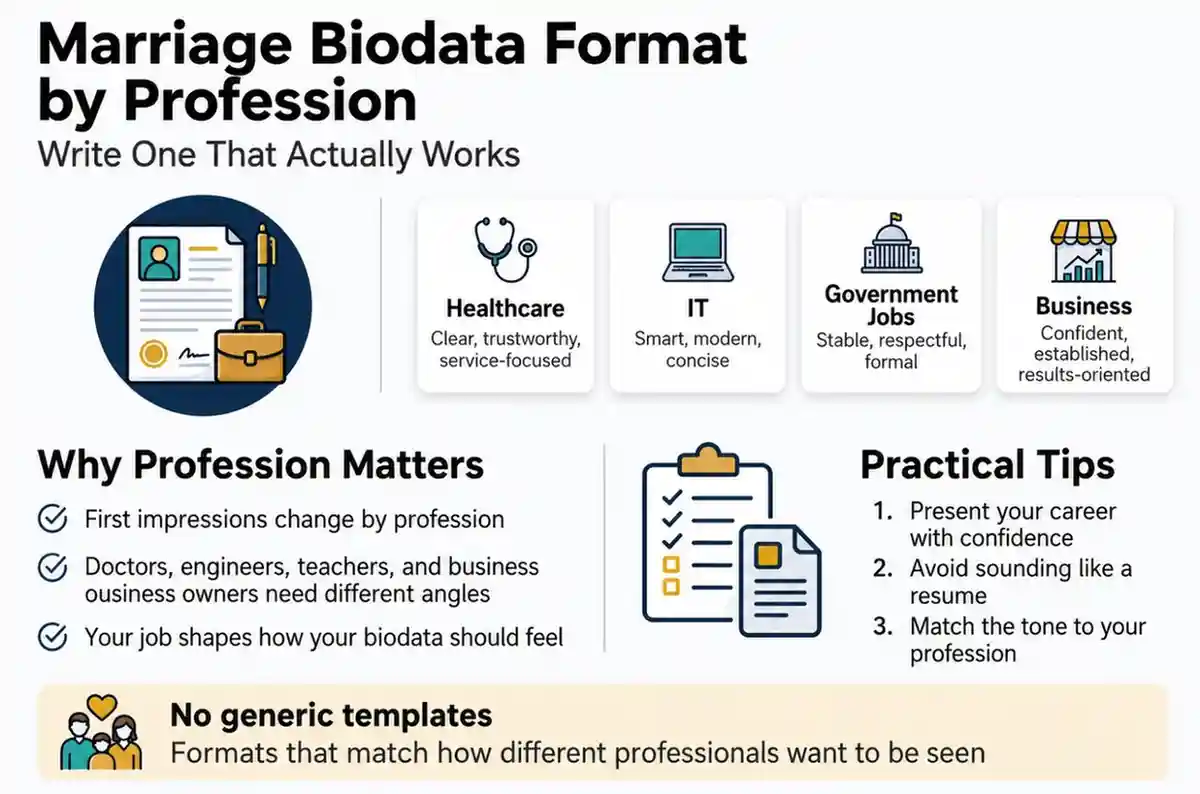
If you're putting together a marriage biodata, you already know the basics — name, age, family background. But here's what empirical matrimonial research demonstrates: your profession and career clarity account for over 82% of initial partner screening decisions made by Indian families.
A doctor's biodata demands medical council credentials and hospital affiliation; an IT professional's profile highlights tech stacks and hybrid flexibility; a business owner's profile focuses on annual turnover and enterprise scale; and a teacher's biodata emphasizes institutional tenure and work-life balance.
This comprehensive guide provides industry-specific benchmarks, statistical compatibility models, and ready-to-use layouts whether you're creating a boy marriage biodata format, customizing for a working woman, or using our free marriage biodata maker to export a clean PDF.
Contents
More Profession Guides
Why Profession Matters in a Marriage Biodata
How Profession Shapes Lifestyle & Schedule Compatibility
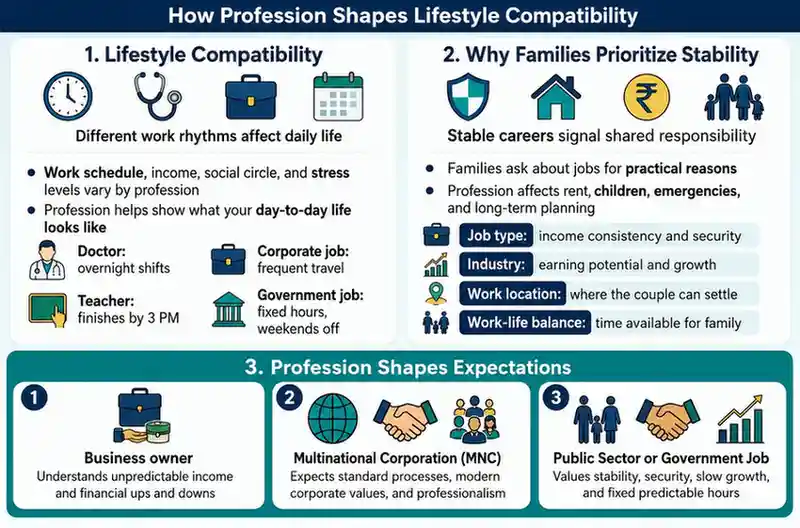
Two individuals may possess compatible values yet experience daily friction if their professional rhythms clash. A resident medical officer working 60+ hour emergency shifts operates on a drastically different timetable than a secondary teacher concluding work at 2:30 PM. In matrimonial decision-making, clear career reporting clarifies daily household schedules.
Work hours, geographic stability, income regularity, and stress levels correlate directly with occupational sectors. Corporate executives frequently encounter domestic and international travel; government officers enjoy predictable hours, gazetted holidays, and housing perks. These realities govern how couples manage shared finances, childcare, and familial responsibilities.
Why Families Prioritize Career Stability in Matches
According to empirical matrimonial demographic studies, career stability ranks among the top three decisive evaluation metrics across Hindu biodatas, Muslim matrimonial profiles, Tamil marriage biodatas, Bengali marriage biodata formats, and regional communities like Marathi biodata formats.
| Industry Sector | Typical Weekly Hours | Compensation Metric | Key Stability Driver | Best Biodata Presentation |
|---|---|---|---|---|
| IT & Software | 40–45 hrs (Hybrid/Remote) | ₹15L – ₹45L+ CTC | High growth, global mobility | Tech stack, employer tier, WFH flexibility |
| Medicine & Healthcare | 55–65 hrs (On-Call Shifts) | ₹12L – ₹50L+ / Private | Lifetime clinical demand, prestige | NMC Reg No., Super-Specialty, Hospital Name |
| Government & PSU | 35–40 hrs (Fixed Timings) | Level 7–14 (7th CPC) + Perks | Job security, pension, housing | Cadre, UPSC/PSC Rank, Gazetted Status |
| Business & Enterprise | Variable (Entrepreneurial) | Annual Net Turnover / Profit | Asset ownership, family enterprise | Industry domain, business age, expansion plans |
| Education & Academia | 30–35 hrs + Vacations | UGC / School Scale | Work-life balance, predictable leaves | Subject specialization, institution board, tenure |
How Professional Background Influences Expectations
A job title communicates far more than compensation — it shapes expectations on both sides of the union. A business owner often seeks a partner who appreciates capital reinvestment and flexible working cycles. An IT professional often prioritizes adaptability to relocation across tech hubs (Bangalore, Pune, Hyderabad, or abroad). A medical doctor benefits from a partner who understands irregular emergency calls.
Selecting the right layout from our marriage biodata templates ensures these nuances are presented respectfully and transparently. For exact phrasing recommendations, explore our expert career phrasing tips.
Key Elements Every Marriage Biodata Should Include
Personal and Family Details That Build Trust
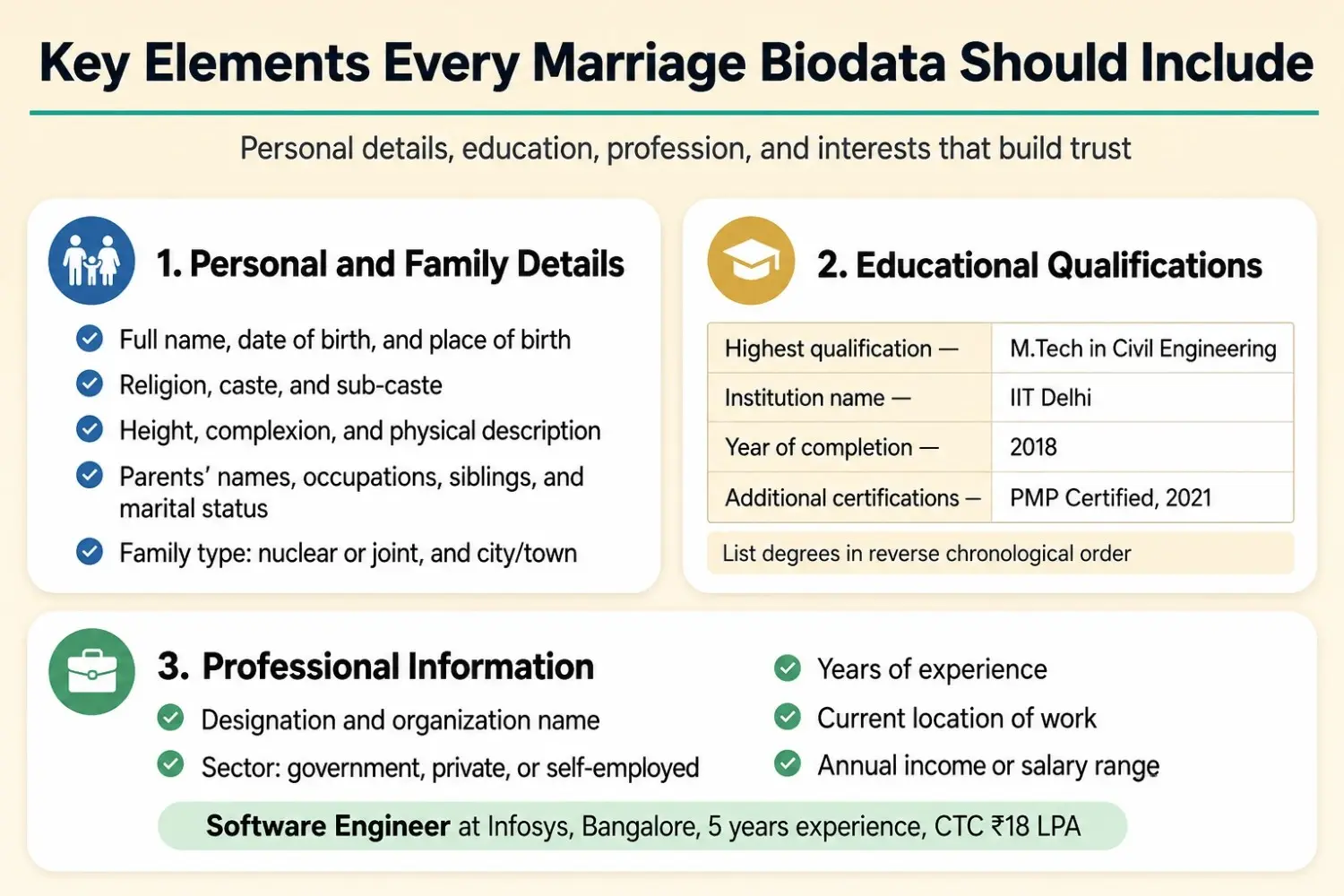
A well-structured marriage profile begins with clear baseline facts. Reference our how to create a marriage biodata walkthrough and verify that your profile includes:
- Full Legal Name, Date of Birth, and Exact Birth Location
- Religion, Caste, and Sub-Caste (aligned with community customs)
- Height, Complexion, and Physical Attributes
- Family Details: Parents' designations, native town, siblings and their marital standing
- Family Structure: Nuclear or joint household background
Educational Qualifications That Establish Credibility
List degrees clearly in reverse chronological order, emphasizing institution accreditation (e.g., IIT, NIT, AIIMS, IIM, State University) and specialization:
| Education Metric | Accredited Format Example | Authority Standard |
|---|---|---|
| Postgraduate Degree | M.Tech (Computer Science), IIT Bombay (2020) | AICTE / MoE Approved |
| Medical Specialty | MD in Pediatrics, KEM Hospital Mumbai (2019) | NMC / MCI Registered |
| Undergraduate Degree | B.Com (Honours), Shri Ram College of Commerce, DU | UGC Recognized |
| Professional Licensure | Chartered Accountant (ICAI, Nov 2021) | ICAI Membership Active |
Professional Information That Highlights Career Value
Specific data points inspire confidence. Instead of vague summaries like "works in private firm," provide clear metrics:
- Designation & Employer: e.g., Senior Product Manager at Microsoft India
- Employment Classification: Permanent Corporate / Gazetted Public Sector / Founder
- Total Experience: 7 Years in Enterprise Cloud Solutions
- Base Location & Mobility: Currently Hyderabad, open to Bangalore/Pune
- Compensation Range: CTC ₹28–32 LPA
Ready to Highlight Your Career with Precision?
Create a clean, standardized matrimonial biodata in minutes with print-ready vector PDF formatting.
Create Your Professional Biodata