

Boy Marriage Biodata Format & Examples
Learn the correct boy marriage biodata format with real examples for each section, common mistakes to avoid, and a free downloadable sample.
Boy Marriage Biodata: Full Format Guide with Examples
So if you've been asked to send across your biodata for a marriage proposal, you've probably already browsed through a few templates online and felt a little unsure about what goes where. That’s normal; most of us have never written one before, and the ones you find online rarely explain why they are structured the way they are; they hand you a blank template and expect you to fill it in.
This tutorial aims to bridge that gap. A boy's marital biodata is more than just a condensed version of a girl's biodata with the pronouns switched. On paper, the sections personal details, education, employment, family history, and contact seem similar, but when the biodata pertains to a male, the order and degree of detail required in each are actually different. If you accomplish that correctly, your biodata will function within the first ten seconds of someone opening it, instead of being obscured by a dozen others.
Below we’ll go through each section properly with real examples of what works and what doesn’t, highlight the mistakes that silently cost boys good matches, and finish with a complete biodata format for a boy marriage sample you can copy straight away or download as a PDF or Word file after creating your own version.
Why the format for a boy's biodata is genuinely different
If you see enough biodatas making rounds in families, you will notice one thing. When a girl’s biodata hits, people usually start by reading about her family, her upbringing and her personality and her career comes a little later in the conversation. Most families, when they get a boy’s biodata, go straight to the question of job.
No one’s written this down as a rule anywhere, but this is how the matchmaking conversation goes in most Indian households, regardless of whether the family is fairly traditional or fairly modern. What gets talked about first is career and financial stability, because that's what most families feel they need to know before they're willing to invest more time in a conversation. Compatibility, values and lifestyle come up later, usually once both sides have already decided the basic profile looks good.
Thus a well-written boy’s biodata is built to fit that pattern, not to fight it. That’s really the whole secret here: put the information people read first.
The correct section order
| Order | Section | Why it goes here |
|---|---|---|
| 1 | Basic personal details | Quick identity check — name, age, height |
| 2 | Career & income | The most-read section for a boy's profile |
| 3 | Education | Backs up the career claim |
| 4 | Family background | Father's/mother's occupation, siblings |
| 5 | Lifestyle & habits | Diet, smoking/drinking, hobbies |
| 6 | Partner expectations | Optional but useful if you have specifics |
| 7 | Contact details | Phone, email, address |
There is some wiggle room here. Some families still prefer education over career, especially if the boy has just finished a postgraduate degree or is young enough in his career that the education is really more impressive than the job title so far. Both orders are perfectly fine. What matters is that career doesn’t end up buried near the bottom of the page, which is the single most common way a boy’s biodata undersells him.
If you have already seen a sample biodata format for a girl and are wondering how different a boy vs girl marriage biodata format is in practice, the honest answer is: the sections are the same, only the emphasis changes. A girl’s biodata starts with family and personal background; a boy’s with career. Neither is "right" in some universal sense; they're just optimised for what each side is usually asked to show first.
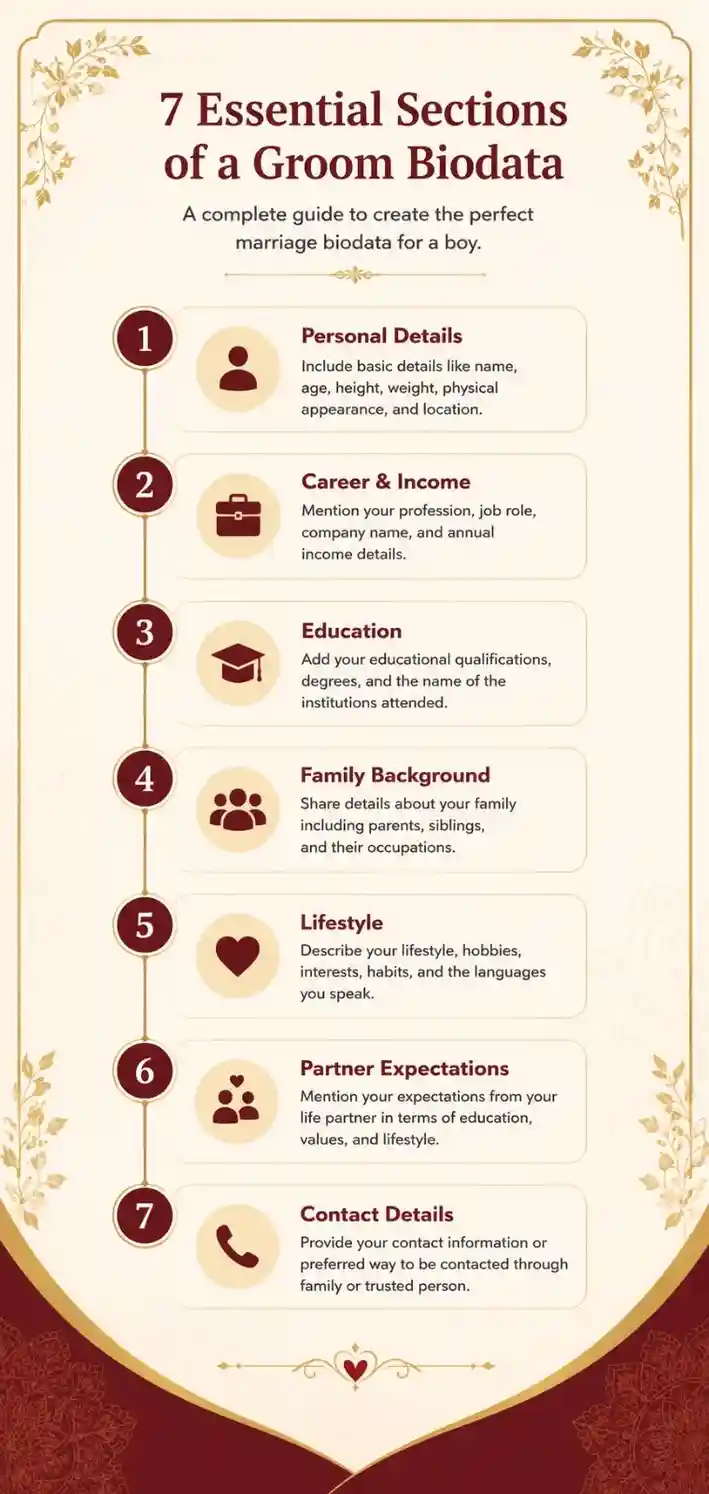
Seven essential sections every groom marriage biodata should include.
Section by section, explained the boys' marriage biodata steps
You know the order now. This is what really goes in each part and where a lot of boys either say too little or say the wrong thing.
1. Personal details
This section is here just to help somebody place who you are in a few seconds, so don't overthink it or pad it out. Name, DOB, age, height, complexion & blood group cover the basics. You should also write “never married” on the marital status line. It may seem obvious, but some families actually look for that specific line to confirm rather than assume. Adding your native place next to your current city helps too. A lot of families care about where your roots are, not just where you work right now.
Here, really, five or six lines are enough. This section of the boy's biodata is to be skimmed through; the actual reading begins in the next section.
2. Career & income (the section that gets read first)
Career and income is part of a boy's marriage biodata that is worth really spending time on. Most boys write “working in a reputed MNC, well settled” thinking it sounds impressive. In practice, it tells the reader very little, and this vague language is one of the main reasons a biodata is quietly put aside.
Make your details specific. For example, "Senior Software Engineer at Wipro, Bengaluru. 6 years experience. Annual Income ₹18 LPA." This gives the family everything they really need to decide whether this looks like a compatible match, while a vague description leaves them wondering what is missing.
This applies regardless of your profession. A doctor can write "MBBS, MD (General Medicine), Sahyadri Hospital, Pune (Doing DM in 2027)", which is clear and future-oriented. A business owner can mention "Family-owned textile business in Ichalkaranji (Est. 1995), turnover approx ₹2 crore", which says much more than just "own business". A government employee can list "Assistant Section Officer, Ministry of Railways, Nagpur (Grade Pay 4600)" to be accurate without sounding boastful. If you work remotely, writing "Freelance UI/UX designer, fully remote (based in Pune, open to relocation)" directly answers what you do and where you plan to live.
On income specifically, if you prefer not to write an exact number, listing a range like "₹10–15 LPA" works well and is much better than leaving the field blank. Leaving income unlisted often leads families to assume a lower figure or think details are being hidden.
3. Education
Concentrate this section on your highest qualification, and one earlier qualification if it really helps explain your background. You don't have to list every school and college you've been to. “Graduate” alone is not informative. B.E. in Mechanical Engineering, COEP Pune, 2019. “Presently doing MBA (Part-time), Symbiosis” tells a much more complete story in about the same number of words and gives both what you’ve been and where you’re going.
4. Family background
Often treated as an afterthought, this section is key. Families use it to see if both households share similar background and values. A simple summary like "Father: Retired Bank Manager (SBI), Mother: Homemaker, Sister: Married & settled in Mumbai" gives readers a clear picture of your household in just a few lines.
Keep it clear and honest: mention parents' occupations, family values, and a quick note about siblings.
5. Lifestyle & habits
Be direct here because this is often the part that keeps a mismatch from happening down the line, after the families have already invested time in the conversation. Include your diet (vegetarian, non-vegetarian, eggetarian), your smoking and drinking habits, and three or four genuine hobbies rather than a long, generic list that sounds like it was copied from somewhere else. “Reading, badminton, weekend trekking” is real. Rarely do people list eight hobbies.
6. Partner expectations (optional)
If you do include this, please keep it short and respectful; one or two lines is plenty. "Looking for an educated, family-oriented partner preferably from Maharashtra, with a stable career or willing to build one," conveys what you are looking for without sounding like a checklist. Long lists of height, complexion and caste preferences piled on top of one another tend to put families off before they have even finished reading, so it is worth resisting the temptation to over-specify here.
7. Contact details
A phone number, email address, and current city are usually sufficient. Including a full home address is optional. Many people prefer not to include complete addresses on copies shared over digital messaging or matrimonial sites, providing it later when conversations progress.
Full sample: boys marriage biodata
So this is how all the above is compiled into one complete boys marriage biodata. Note how each section is concise, specific and easy to scan.
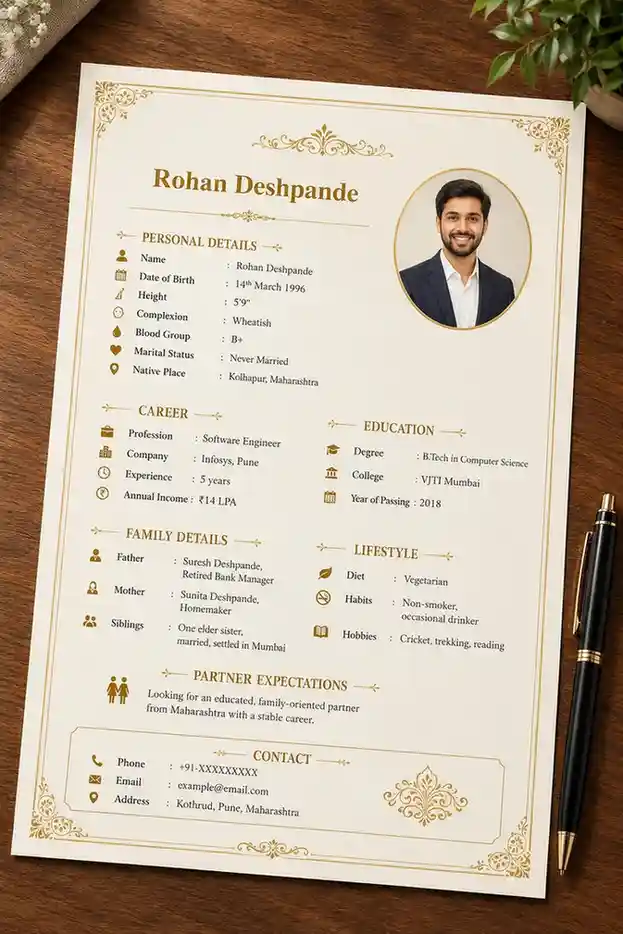
Sample marriage biodata for a groom.
MARRIAGE BIODATA
Sample Profile for Groom
1. Personal Details
Full Name: Rohan Deshpande
Date of Birth: 14th March 1996
Height: 5'9"
Complexion: Wheatish
Blood Group: B+
Marital Status: Never Married
Native Place: Kolhapur, Maharashtra
2. Career & Income
Occupation: Software Engineer, Infosys, Pune
Experience: 5 years
Annual Income: ₹14 LPA
3. Education
Qualification: B.Tech in Computer Science, VJTI Mumbai, 2018
4. Family Background
Father: Suresh Deshpande, Retired Bank Manager
Mother: Sunita Deshpande, Homemaker
Siblings: One elder sister, married, settled in Mumbai
5. Lifestyle & Habits
Diet: Vegetarian
Habits: Non-smoker, occasional drinker
Hobbies: Cricket, trekking, reading
6. Partner Expectations
"Looking for an educated, family-oriented partner from Maharashtra with a stable career."
7. Contact Details
Phone: +91-XXXXXXXXXX
Email: example@email.com
Address: Kothrud, Pune, Maharashtra
Keep in mind that the main goal is a simple, clear, and honest biodata kept to one page with real details. Specific and clear information always works better than polished, vague descriptions.
Common Mistakes to Avoid in a Boy's Marriage Biodata
There are a few patterns that show up again and again in boys' biodatas, and each one is easy to fix once you know to look for it.
- Vague career details. Phrases like "private job" or "own business," with no further detail, tend to read as evasive rather than modest.
- Skipping the father's occupation. Families notice this gap even when they don't say so directly, and it's an easy thing to simply include.
- Old or casual photos. A recent photo (taken within the last year in formal or semi-formal attire with a plain background) works best. Group photos or heavily filtered images usually do not create a good impression.
- Overly long partner expectations. A short, respectful sentence lands far better than a detailed checklist of preferences.
- Copying a girl's biodata format directly. For a groom, career information should come first before personal details. Copying a generic format is a common oversight.
- Letting it run longer than one page. A biodata is meant to be a summary, not a resume. If it's running long, it usually means something needs to be trimmed, not added.
Learn the common subconscious red flags families spot and how to fix them quickly.
Boy's Biodata Formats by Community & Religion
A boy's marriage biodata follows the same core structure everywhere, but a few fields change depending on community and religion (things like gotra, horoscope details, or family lineage). If you're preparing this for a Muslim, Marathi, or Hindu family specifically, check the format tailored to that community below.
Muslim Marriage Biodata Format
Islamic themes & headingsMarriage Purpose Biodata
4 Copy-Paste Word & PDF FormatsMarathi Biodata Maker
Traditional Maharashtrian layoutsHindu Marriage Biodata Format
Gotra, Rashi & Vedic detailsTamil Marriage Biodata
Pure Tamil, Jathagam & Kula DeivamBengali Marriage Biodata
Gotra, Desh, Alpana & PDFKannada Marriage Biodata
Gotra, Nakshatra, Rashi & PDFProfession Biodata Guides
Doctors, Engineers, Govt JobsHindu Biodata in 7 Steps
Vedic details & Gotra GuideDownload Editable Microsoft Word (.DOCX) Formats:
Frequently Asked Questions
Common questions and expert advice on writing a boy's marriage biodata.