
How to Write Biodata for Marriage: A Practical Writing Guide
By Baliram Giri, Founder, Biodata99
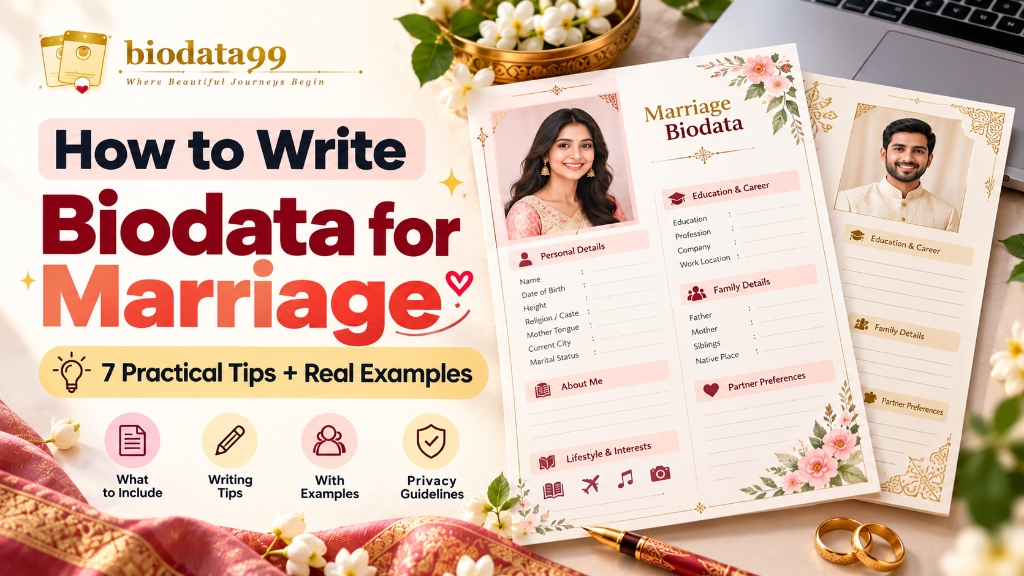
A marriage biodata is not difficult because of the fields. Most people know they need to mention their name, age, education, profession, family and contact details. The difficult part is how to write those details naturally.
After reviewing hundreds of marriage biodatas, I have noticed the same problem again and again. People often try to make their profile sound impressive, so they fill it with words like simple, caring, honest, family-oriented, modern and understanding. The result is usually a biodata that could belong to almost anyone.
A good marriage biodata should do the opposite. It should help the reader understand who you are, what your life looks like and what kind of relationship you hope to build. This guide focuses on the writing process - what to say, how to say it and which details are worth including.
How to Start Writing Your Marriage Biodata
Before opening a template, write your information as plain text. Do not worry about fonts, borders, colours or photographs yet. First decide what another family should know about you after reading the page for one or two minutes.
A useful profile answers five questions: Who is this person? What does this person do? What is the family background? What is this person like in daily life? What kind of partner or relationship are they looking for?
Think of the biodata as a personal introduction, not a job application.
Many readers first look for a marriage biodata format PDF and Word example. The format tells you which fields to include; this guide focuses on how to phrase those fields naturally. For the field structure, see our marriage biodata format guide.
How to Write Each Section of a Marriage Biodata
Break your preparation into these seven core sections. Each section has a specific purpose in building trust and mutual understanding.
1. Personal Details: Keep the Facts Clear
The personal-details section should be easy to scan. Depending on your family and community, it may include full name, age or date of birth, height, current city, native place, mother tongue, religion or community, caste, Gotra, Rashi, Nakshatra and marital status. You do not need every possible field just because you found it in another bio data for marriage format. Include what is genuinely relevant.
2. Education and Career: Explain, Don’t Brag
A marriage biodata should mention education and career clearly, but it does not need to look like a resume. Replace vague praise with concrete information.
- Weak: “Highly qualified professional working in a reputed multinational company.”
- Better: “B.Tech in Computer Science. Currently working as a Software Engineer with a product company in Bengaluru.”
- Self-employed: “I run a small electrical contracting business in Pune and have been managing it for the past six years.”
If you work outside India, state the role and location clearly. If income is relevant to your matchmaking context, it can be included separately without turning the whole profile into a financial statement.
3. Family Details: Give Context Without Writing a Family History
Family information matters in many Indian matrimonial introductions, but a biodata does not need a biography of every relative. Keep the relationships and occupations clear, then add one line that describes the family culture.
4. About Me: This Is Where Your Biodata Becomes Personal
The About Me section is often the difference between a profile that feels genuine and one that feels copied. Keep it around three to five sentences. Think about your normal routine, interests, personality, priorities and the type of life you are building.
Notice that the paragraph does not repeatedly say “I am caring” or “I am family-oriented.” The details demonstrate those qualities. If you struggle to write about yourself, ask a sibling or close friend what makes you different.
5. Lifestyle: Use Real Details
Bad: “Modern, traditional, spiritual, adventurous and fun-loving.” Better: “I enjoy travelling two or three times a year, prefer home-cooked food during the week and like spending Sundays with family.”
Three real details are usually more useful than ten generic interests. Mention food, fitness, travel or social habits when they are genuinely relevant.
6. Partner Preferences: Be Clear Without Sounding Demanding
Too rigid: “Looking for a fair, beautiful, slim, highly educated girl from a good family with a high-paying job.”
More useful: “Looking for a kind and emotionally mature partner who values family, communication and personal growth. I would be happy to meet someone who has her own interests and career plans, and believes in supporting each other.”
You can still mention genuine preferences such as location, language, community, education or willingness to relocate. The key is to separate important preferences from a long list of demands.
7. Contact Details: Share Only What You Need
Use one primary contact method, such as a parent’s or the candidate’s phone number. A marriage biodata can travel through WhatsApp and family groups, so avoid publishing several numbers, unnecessary email addresses or every social-media account.
How to Write a Girl’s or Boy’s Biodata Without Making It Generic
The core writing principles are the same for both men and women. The difference is usually which information deserves more attention for that individual. For one person, career, education and location may matter most. For another, family background, lifestyle, language or plans after marriage may deserve more space.
For a dedicated marriage biodata for a girl structure, use the existing Biodata99 guide. For a detailed biodata format for marriage for boy reference, use the boy-specific page. Keep this article focused on wording so the pages support each other rather than compete.
How to Write a Marriage Biodata in English, Hindi or a Regional Language
The language can change without changing the underlying writing approach. Families may search for a marriage biodata format in Hindi or a Marathi marriage biodata format and still need the same core information: personal details, education, work, family, personality and expectations. You can adapt headings and community-specific terminology while keeping the wording easy to understand.
The same principle works for a Hindu marriage biodata maker, Tamil marriage biodata maker or Kannada marriage biodata maker workflow: add the fields that matter to that community, but do not let traditional fields hide the person behind them. You can also create regional profiles with our Marathi marriage biodata maker.
Someone searching “how to make shadi ka biodata” may start with a template, but the best result still depends on the quality of the writing.
What Should Not Be Included
A marriage biodata should introduce you, not expose your private information. Never include Aadhaar numbers, PAN numbers, bank-account details, UPI credentials, OTPs, passwords, copies of identity documents or an exact residential address. For an initial introduction, your city and state are generally enough.
Never include government identity numbers, financial accounts, UPI IDs, passwords, or house plot numbers. Remember that matrimonial biodatas are frequently forwarded to distant family circles, matrimonial brokers, and WhatsApp groups.
Also think carefully before publishing personal social-media profiles or sensitive family information. A document shared once can easily be forwarded to people you do not know.
How to Turn Your Writing Into a Finished Biodata
Once the wording is ready, choose a clean design. Many people first look for a marriage biodata template free or a marriage biodata format PDF and Word option. That is fine, but the template should come after the writing. A beautiful design cannot fix vague content.
You do not need to install a native app to create marriage biodata online. Biodata99 is a browser-based maker that works on mobile and desktop. Someone searching for a marriage biodata maker app can use the browser editor instead, without the article misrepresenting Biodata99 as a downloadable app.
When the content is ready, create your biodata for marriage online or browse the free marriage biodata templates.
Three Lines You Can Adapt for Your Own Biodata
You can adapt these three field-tested examples directly for your own profile. Use the copy buttons to transfer them into your draft:
How Long Should a Marriage Biodata Be?
For an initial introduction, one well-organized page is often enough. If you have important community details, extensive family information or a significant professional background, a second page can make sense. What matters is readability. Before sharing the final file, open it on your phone. If the text is difficult to read without zooming, the layout needs another round of editing.
Final Check Before You Share
Read the biodata once without thinking about SEO, design or family expectations. Does it sound like a real person? Are the important facts immediately clear? Have you removed unnecessary information? Does the About Me section contain real details? Are the partner preferences respectful and realistic? Can someone read the whole page comfortably on a mobile phone?
That final reading often catches more problems than another round of formatting. A good marriage biodata does not need to make you sound extraordinary. It needs to make the right impression of the real person behind the page. Avoid common marriage biodata mistakes that reduce responses before circulating your profile.
When your wording is ready, create your marriage biodata online with Biodata99 or explore the free marriage biodata template collection. For more advice on formatting, regional customs, and matrimonial preparation, explore our complete library of Biodata99 marriage guides.
Frequently Asked Questions
Clear, practical answers about writing, section phrasing, privacy, and exporting matrimonial biodatas.
Start with accurate personal information and then explain your education, career, family, lifestyle and personality in simple language. Strong profiles use specific examples instead of stacking generic adjectives.
Baliram Giri
Founder & Lead Architect, Biodata99Baliram Giri is the founder of Biodata99. Dedicated to simplifying matrimonial introductions across Indian communities, he combines clean typography, privacy-first engineering, and practical writing coaching to help individuals present their authentic stories with dignity and confidence.
Continue Exploring Matrimonial Guides
Marriage Purpose Biodata Format Guide
Field-by-field structural guide explaining every matrimonial data point.
Quality CheckWhy Marriage Biodatas Get Ignored
Common mobile formatting pitfalls, photography errors, and tone mistakes to avoid.
Bride ProfilesMarriage Biodata Format for Girl
English samples, Word (.docx) downloads, and bride-specific section guidelines.
Groom ProfilesBiodata Format for Marriage for Boy
Structured career, family, and Vedic horoscope fields for grooms.