

biodata99.com Logo
Vedic Matrimonial Guide8 min readUpdated Aug 2026

How to Create a Hindu Marriage Biodata in 7 Steps

Learn how to create a professional Hindu marriage biodata with our easy 7-step guide. Download free templates and find the perfect format for your profile.

BG
Baliram GiriAuthor Profile

Founder & Matrimonial Biodata Specialist

Fact-Checked for Vedic & Astrological Accuracy
How to Create a Hindu Marriage Biodata in 7 Steps

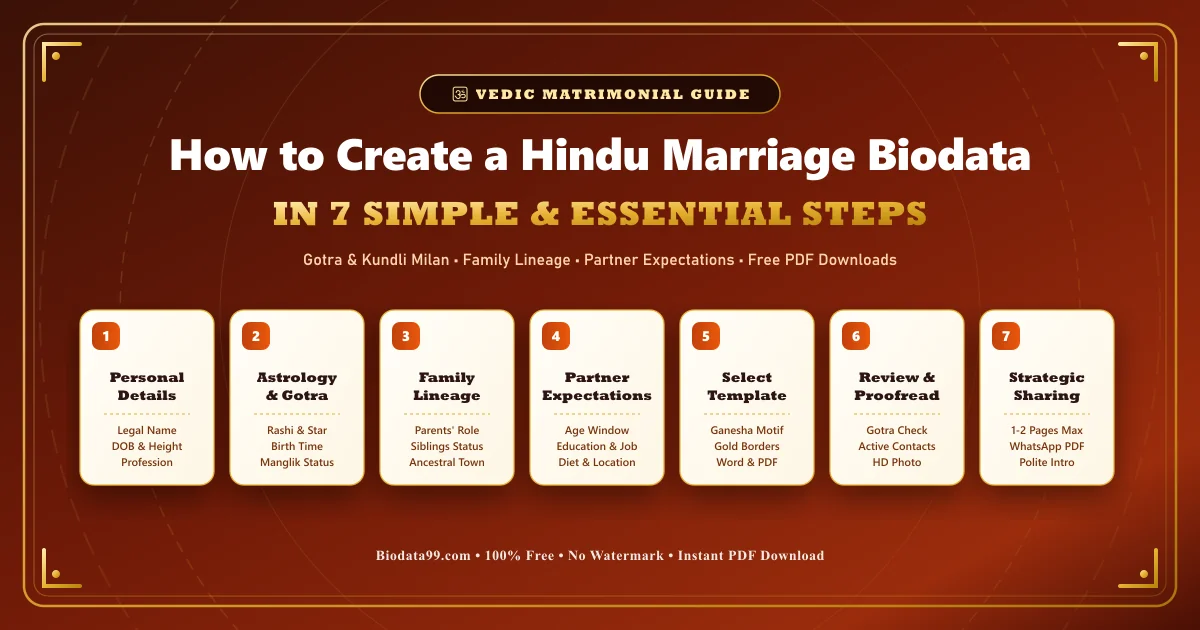
Quick Summary: 7 Steps to a Perfect Hindu Biodata

1Personal Details: Legal name, verified DOB, height & profession.
2Astrological Data: Gotra, Rashi, Nakshatra, birth time & Manglik status.
3Family Lineage: Parents' roles, siblings, family type & ancestral roots.
4Partner Preferences: Balanced age, education, values & location outlook.
5Template Selection: Sacred Hindu motifs (Ganesha, Kalash) or sleek lines.
6Proofreading & Photos: Double-check Gotra, active numbers & HD photo.
7Strategic Sharing: 1–2 page PDF distribution with polite introductory etiquette.
1

Step 1: Document Your Personal and Physical Details

A good hindu marriage biodata format creates a positive first impression. This opening section acts like a profile header. It introduces who you are before families read further. Clear and accurate details build immediate trust.

Fill out each field below carefully:

  1. Full Name: Write your legal name as shown on official IDs. Avoid informal nicknames.
  2. Date of Birth & Age: Use a standard date format (DD/MM/YYYY) and list your current age. Note that the legal marriage age for a Hindu groom is 21 years in India.
  3. Height & Weight: State your exact height in feet/inches and cm. Accurate details prevent confusion during family meetings.
  4. Education: List your highest degree first. Include your college name and graduation year.
  5. Profession & Income: State your job title, employer, and city. Clear job titles build confidence.
  6. Location: Mention your current city of residence along with your native hometown.

Photo tip: Attach a clear, recent portrait with good lighting and a clean background.

Next, add your astrological information — including Gotra, Rashi, Nakshatra, and Manglik status — for horoscope matching.

2

Step 2: Incorporate Essential Astrological Data

Astrological details are central to many Hindu matrimonial discussions. Because most married Hindus in India marry within their faith community, horoscope compatibility (Kundli Milan) is widely practiced. Accurate birth data ensures seamless matchmaking.

Accuracy matters: Small errors in birth time or Nakshatra can alter a Kundli chart. Always verify details with your family Kundli before sharing.

Key astrological details to include:

  1. Gotra & Caste: Spell your Gotra and community name in full to verify lineage compatibility.
  2. Rashi (Moon Sign): Mention your Vedic Moon sign calculated from your birth chart.
  3. Nakshatra (Birth Star): Include your birth star and Charan/Pada (quarter) if available.
  4. Manglik Status: Clearly write "Non-Manglik", "Manglik", or "Anshik Manglik".
  5. Place of Birth: List the exact town or city and state where you were born.
  6. Time of Birth: Provide the exact time (with AM/PM) from your official birth records.

After completing your horoscope fields, present your family background clearly in the next section.

3

Step 3: Detail Family Background and Lineage

Family background is an important factor in Indian matrimony. Sharing information about your parents and siblings helps prospective families understand your cultural roots and home environment.

  1. Parents' Occupations: List both father's and mother's full names along with their profession or retirement status.
  2. Siblings: Mention brothers and sisters, their marital status, and occupations.
  3. Family Type: State whether your family is Nuclear or Joint.
  4. Family Values: Add a brief sentence describing your family culture (e.g., traditional values with modern outlook).
  5. Ancestral Roots: Mention your native town and paternal/maternal origins:

Paternal side: Grandfather's name and native village/city

Maternal side: Grandfather's name and family origin

Key relatives: Extended family background if relevant

Privacy note: Keep financial and personal disputes private. Highlight positive family qualities.

Next, describe your partner expectations gently to help find compatible matches.

4

Step 4: Outline Partner Expectations and Preferences

Sharing your preferences helps prospective matches know if you share compatible goals. Phrasing expectations respectfully makes your profile welcoming and saves time for both families. Note that Hindu marriage law outlines key conditions for marriage, and clear expectations support mutual understanding.

Guidelines for writing partner preferences:

  1. Age and Height: Give a reasonable range (e.g., "Age: 26–30 years, Height: 5'4\"–5'9\"").
  2. Education & Career: Mention general qualifications (e.g., "Graduate or Postgraduate in any field").
  3. Diet & Lifestyle: State dietary habits clearly (e.g., "Vegetarian family; prefer a vegetarian partner").
  4. Relocation: Mention location preferences or openness to move to other cities.

Tip: Be flexible. Keep essential criteria clear, but stay open on minor preferences to welcome good matches.

Once your content is ready, select a clean design template to present your biodata professionally.

Create Free Hindu Biodata Online

Design Your Hindu Marriage Biodata in 2 Minutes

Choose traditional Ganesha & Vedic border templates. Download high-resolution PDF with zero watermark — 100% private, no account required.

5

Step 5: Select and Download a Professional Template

A neat layout makes your details easy to scan. You can create a ready profile using our Biodata99 Hindu Biodata Maker or pick from our biodata template collection.

Tips for choosing the right template:

  1. Choose Word or PDF: Use Word (.docx) for editing drafts. Use PDF format for sharing so fonts and layouts stay locked on all devices.
  2. Select Design Style: Traditional borders with Ganesha motifs suit traditional families. Minimalist frames work well for modern profiles.
  3. Ensure Readable Fonts: Use clean fonts like Calibri, Arial, or Times New Roman at 11–12pt font size.
  4. Check Layout Spacing: Keep margins balanced and ensure sections do not overflow unnecessarily.

Before sharing your completed biodata, do a quick final check for spelling and contact numbers.

6

Step 6: Review and Finalize for Distribution

A careful review ensures your biodata is free of typos and ready for digital sharing or email.

  1. Double-Check Names and Gotra: Proofread all spellings carefully. Gotra accuracy is essential for family verification.
  2. Verify Contact Numbers: Confirm that primary and secondary phone numbers are active and include country codes.
  3. Review Photo Quality: Use a clear, sharp picture with good lighting.
  4. Verify Horoscope Info: Re-check DOB, time, and Nakshatra against official records.
  5. Save as PDF: Name the file cleanly (e.g., Rahul_Sharma_Marriage_Biodata.pdf) for easy reference.
  6. Share Respectfully: Send with a warm, polite introductory message. Note that marriage awareness across India continues to rise, making thoughtful communication appreciated by families everywhere.

Here is a quick summary of key best practices for your Hindu biodata.

7

How to Summarize Your Hindu Biodata Strategy

Follow these 4 core principles to make your Hindu matrimonial profile stand out:

1. Prioritize Accuracy

Verify birth details, Gotra, and phone numbers before sending. Accurate data prevents misunderstandings.

2. Balance Career & Family

Highlight both career achievements and family background. Both aspects are valued equally by families.

3. Elegant Layout

Use a clean design tailored for Hindu matrimonial profiles. Clear sections make reading effortless.

4. Keep to 1–2 Pages

Keep the document concise. A single-page or two-page format is easy to read and share across digital devices.

A well-made Hindu marriage biodata is your first step toward meaningful matrimonial conversations. Follow these 7 steps to present your profile with clarity and confidence.

BG

Written by Baliram Giri

Founder, Biodata99

Baliram Giri is the creator of Biodata99, dedicated to helping thousands of Indian families create elegant, privacy-first matrimonial biodatas across Hindu, Marathi, Muslim, and modern community formats.

Explore Related Marriage Biodata Formats & Guides

Tailor your biodata specifically to your background, community, and profession.

Hindu Matrimonial FAQ

Frequently Asked Questions

Expert answers on Hindu astrological data, Gothra verification, and template formatting.

A complete Hindu matrimonial biodata should include your Gothra (clan lineage), Rashi (Moon sign), Nakshatra (birth star with Pada/quarter if known), Manglik status (Manglik or Non-Manglik), exact time of birth, and place of birth (city, state, country). These fields allow astrologers and prospective families to perform accurate Kundli Milan and horoscope matching.

In traditional Hindu marriage customs, Gotra is used to verify exogamy (preventing marriage within the same ancestral lineage / Sagotra). The exact time of birth is equally crucial because even a 10-15 minute variation shifts planetary ascendants (Lagna) and planetary houses, altering the entire compatibility reading.

You can create a free Hindu marriage biodata directly on Biodata99 without signing up. Choose a Hindu-themed template with Lord Ganesha or Vedic borders, enter your personal, astrological, and family details, upload a clean photo, and download your high-resolution PDF or JPEG instantly.

If you do not have an official Kundli, consult a verified family astrologer or write 'Kundli available upon request / To be matched' rather than guessing. Leaving an unverified claim can cause misunderstandings during horoscope matching later.

PDF is universally recommended for digital sharing or email because it locks fonts, photos, and page layouts across all mobile phones and desktop computers. Microsoft Word (.docx) is best kept as your editable master draft on your computer.

Yes. Biodata99 fully supports English, Hindi, Tamil (தமிழ்), and Marathi. You can type in your preferred script or language to respect your family's cultural comfort.

Ideally, keep it strictly to 1 or 2 pages. A concise 1-page A4 format ensures prospective in-laws and matchmakers can review key details (education, career, gotra, family) in 30 seconds without feeling overwhelmed.

Ready to Create Your Hindu Marriage Biodata?

Start with our free Hindu templates, fill in your details securely, and download your print-ready PDF in minutes.